Answer engine optimization so your page gets quoted
We write the page so an answer engine can quote it. A direct reply, your name as the source, and markup on the question and the answer.
What AEO is
AEO treats the page as an answer, not only as a candidate for a blue link. The first sentences define the term or answer the question. Later sections add the conditions, the exceptions, and the proof. That order is deliberate.
People also ask boxes, featured snippets, voice results, and AI Overviews all prefer a passage that can stand alone. Writing that passage is editorial work. Tagging it is technical work. Both are in scope.
How AEO differs from SEO
SEO earns a listing on a results page: crawlable URLs, relevant copy, internal links, and authority you did not invent. AEO aims at the quoted answer above or beside those links. A page can do both. A page that is only a definition, with no business behind it, usually should not.
AEO does not replace a service page, a city page, or a case study. It changes how those pages open. The SEO, AEO, and GEO essay walks through which one a small business should buy first.
Schema that helps, when the page agrees
FAQPage, Question, Answer, and SpeakableSpecification are the usual set. DefinedTerm fits a page that actually defines something, such as this one. HowTo fits a real process. They are added when the visible HTML says the same words.
JAX Epoxy Floors and St. Johns County Living already publish FAQ and speakable markup. That's the implementation. We are not saying either site owns an AI Overview.
How this applies, by the kind of site
SEO, answer engine optimization, and generative engine optimization are the same jobs at every size. SEO makes a real URL eligible to rank. AEO makes a passage something an answer engine can quote. GEO makes the business something ChatGPT, Gemini, Claude, and Perplexity can describe. We don't guarantee a placement. The page count and what stays private change with the product. On all of them we start by talking to the people who share the process, then we decide what to simplify before we write a page.
01
Simple website
A local practice, a contractor, a club, or a short brochure that needs to be found and called.
A coatings site, a realtor introduction, a garden club domain.
- SEO
- A small set of real pages: the offer, the places you actually serve, and a way to call. Titles, canonicals, one sitemap, and schema that matches the visible page. Search Console when you're ready to measure. We stop adding city pages when the proof stops.
- AEO
- The first sentences answer the question a customer already asks. FAQs are those questions.
- GEO
- One business name, one phone, one place, repeated. An llms.txt file that lists the pages worth reading. If you have a Google Business Profile, it should say the same thing as the site.
02
Transaction site
A quote, a direct booking, a calculator, or a checkout path where the page has to do more than explain.
A rental that takes a waiver, an investment calculator, a quote request after the service is clear.
- SEO
- Every step a stranger should find is its own URL. The thank-you page, the account, and the half-finished form stay out of the index. Old paths redirect. The sitemap lists the public steps only.
- AEO
- Before the button, the page says what's included, how the request works, and the limits. A calculator isn't tax advice. A waiver on the site isn't a lawyer's opinion.
- GEO
- We write fees, rules, and availability so an answer engine doesn't invent them. llms.txt points at those pages. If the inquiry has to reach a person, the form lands in the CRM you already use.
03
SaaS product
Software with a public explanation and a private product. Often two hosts, not one.
Garden software on its own domain, a foundation site beside it, a marketing site plus an app login.
- SEO
- The marketing host is what gets indexed. Logins, workspaces, and customer records are noindex. Feature and use-case pages are documents, not screenshots inside the app. New work is built in Cursor on Next.js.
- AEO
- One page defines the product in a paragraph a buyer can repeat. Then the conditions: who it's for, what the separate logins are, and what you haven't claimed yet.
- GEO
- Keep the product name stable. llms.txt lives on the public site. The app host doesn't have to be the page an answer engine cites. Say what the product does, or the model will guess.
The files are the same on all three: a sitemap of public URLs only, robots.txt that matches what should be read, schema that repeats the visible page, and llms.txt. SEO, AEO, and GEO are one stack. We don't sell them as three unrelated retainers. New sites are Next.js projects we build in Cursor.
Proof in the portfolio
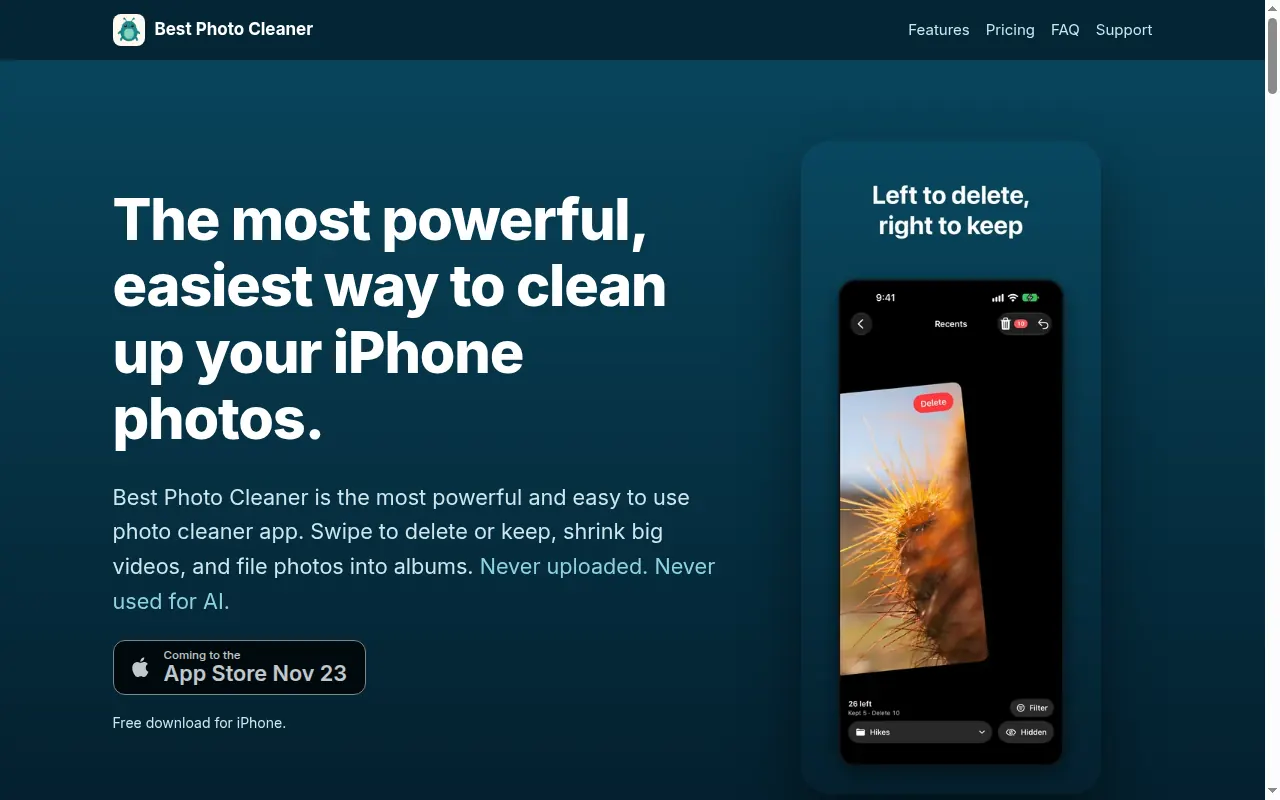
- Apps & SaaSBest Photo CleanerMarketing site for an iPhone photo cleaner. The App Store date on the page is Nov 23, 2026.
- FitnessBody By NeglectFitness portal with 56 standards and nutrition calculators.

- Home servicesJAX Epoxy FloorsCoatings site with city pages and a quote path. November 1 overall 95.

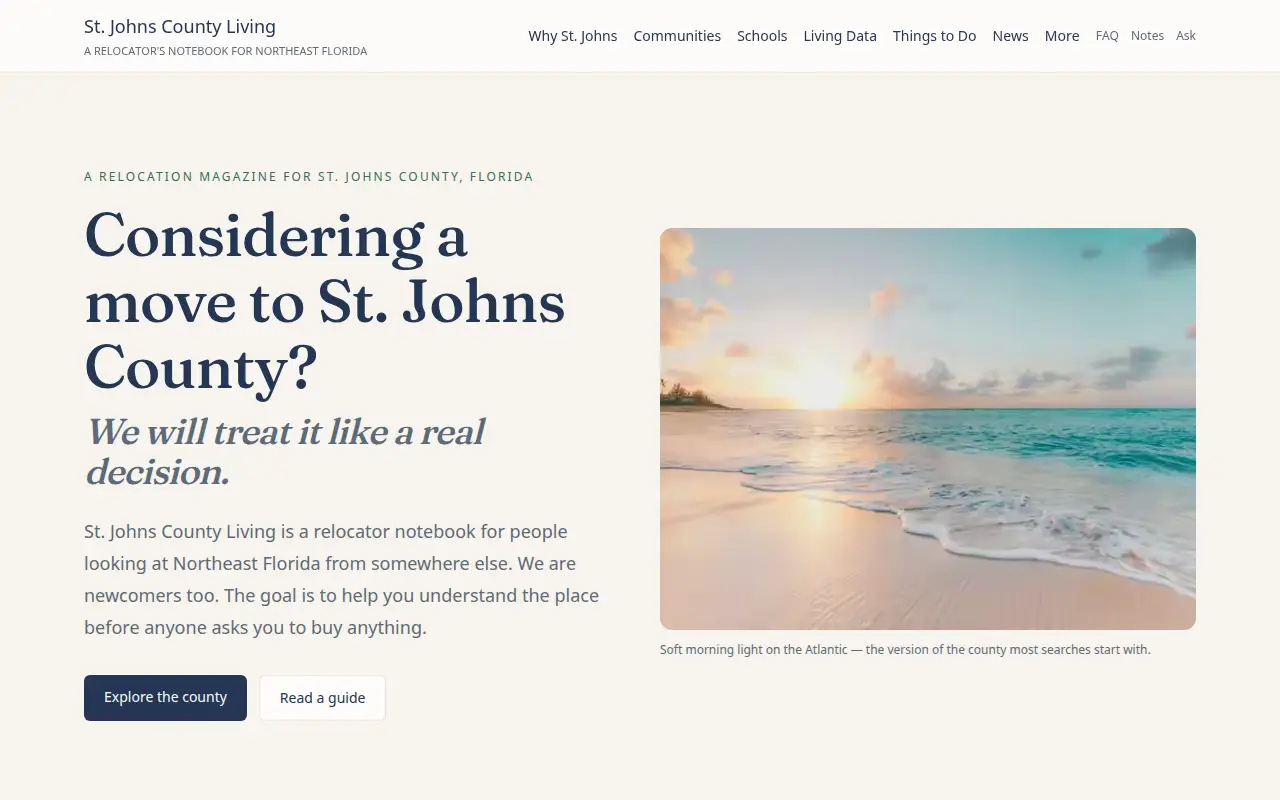
- Real estateSt. Johns County LivingRelocation guide for St. Johns County. November 1 overall 92.
Questions
What is AEO?
Answer engine optimization is the practice of writing and marking pages so an answer engine can quote them. The page leads with the answer, then the detail. FAQ schema and speakable markup tell a parser where that answer sits. A citation is not guaranteed.
How is AEO different from SEO?
SEO works to earn a result on the search page. AEO works to be the short answer those systems quote, including featured snippets, voice answers, and AI Overviews. You usually need the SEO foundation first. A quote with no underlying page is fragile.
What schema helps AEO?
FAQPage for real questions and answers on the page, SpeakableSpecification for the passages that can be read aloud, and DefinedTerm when the page defines a phrase. Organization and Service schema still matter so the answer is tied to a business.
Can a small business win AI Overviews?
It can be cited. Winning is the wrong verb. Overviews change, and they do not cite everyone who added an FAQ. A small business with a clear service, a real location, and a page that answers one question cleanly is a better candidate than a thin page stuffed with synonyms. There is no promise of placement.
The work stays with Dashworth.
Call or text 650-393-3378. We meet in Northeast Florida and San Mateo, and we take contract roles inside larger companies. No account managers, no handoffs.