SEO for Jacksonville and St. Augustine
We do SEO by fixing the structure. Pages that match real services, links between them, a sitemap, and schema that names the business. A ranking is an outcome. We do not sell it as a line item.
What SEO includes
A typical engagement covers the information architecture, titles and descriptions, canonical URLs, indexation rules, internal links between services and proof, and structured data. Content is written to answer a specific query in the first sentences, which also feeds answer engine optimization.
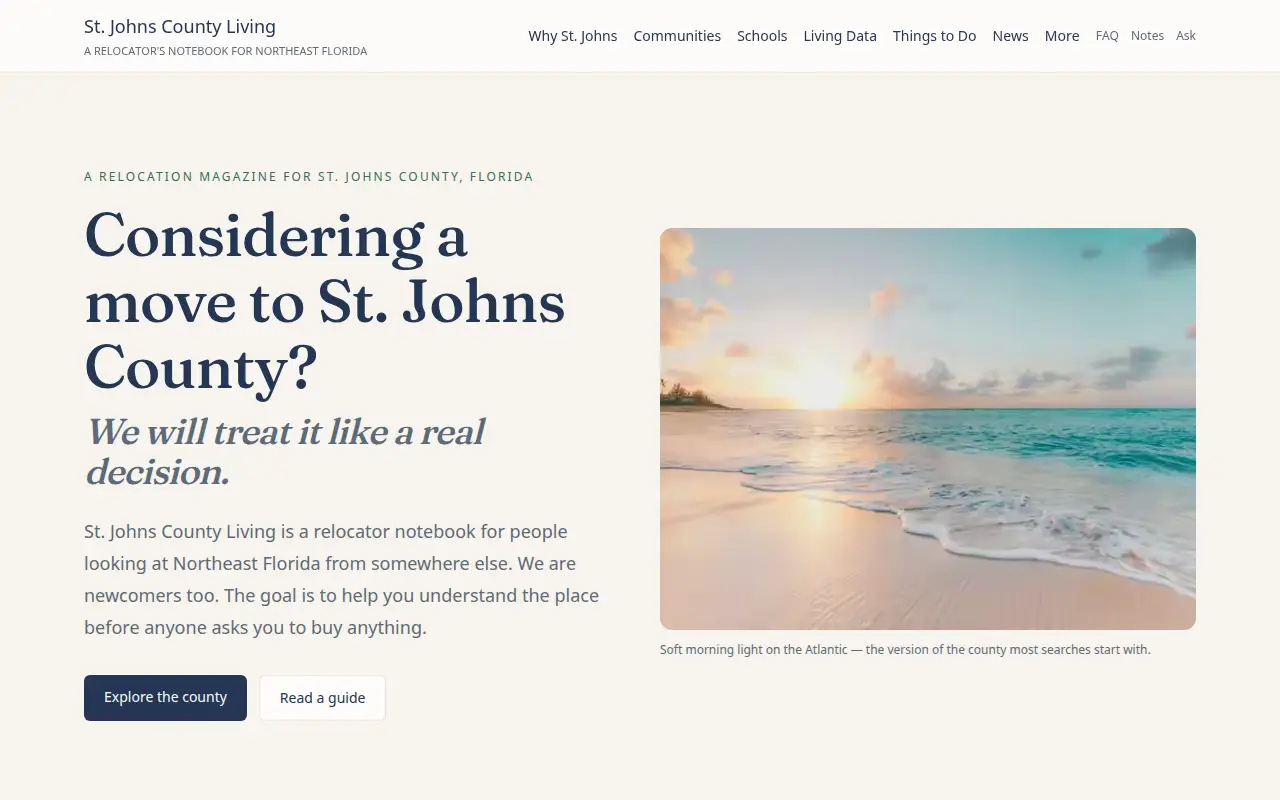
Technical cleanup matters more than a blog nobody asked for. JAX Epoxy Floors shows the pattern: a service-area silo, FAQ markup, a large sitemap, and IndexNow submissions. St. Johns County Living shows the editorial version: a guide with place schema and a sitemap of 109 URLs.
How measurement works
We start measuring when Google Search Console, and an analytics tag if you want one, are actually connected. Several of Dashworth sites have Google Tag Manager installed. That's not a published traffic report.
This website doesn't print rankings, sessions, or revenue for any project. We have not pulled those figures for a public report. When they exist, they belong in the case study next to the date we read them.
Northeast Florida queries, national sites
Phrases like SEO in Jacksonville or St. Augustine belong on pages about local work. A national business gets a national structure. We do not stuff every city into a footer. City pages are a local SEO decision, and only where you actually serve that place.
How this applies, by the kind of site
SEO, answer engine optimization, and generative engine optimization are the same jobs at every size. SEO makes a real URL eligible to rank. AEO makes a passage something an answer engine can quote. GEO makes the business something ChatGPT, Gemini, Claude, and Perplexity can describe. We don't guarantee a placement. The page count and what stays private change with the product. On all of them we start by talking to the people who share the process, then we decide what to simplify before we write a page.
01
Simple website
A local practice, a contractor, a club, or a short brochure that needs to be found and called.
A coatings site, a realtor introduction, a garden club domain.
- SEO
- A small set of real pages: the offer, the places you actually serve, and a way to call. Titles, canonicals, one sitemap, and schema that matches the visible page. Search Console when you're ready to measure. We stop adding city pages when the proof stops.
- AEO
- The first sentences answer the question a customer already asks. FAQs are those questions.
- GEO
- One business name, one phone, one place, repeated. An llms.txt file that lists the pages worth reading. If you have a Google Business Profile, it should say the same thing as the site.
02
Transaction site
A quote, a direct booking, a calculator, or a checkout path where the page has to do more than explain.
A rental that takes a waiver, an investment calculator, a quote request after the service is clear.
- SEO
- Every step a stranger should find is its own URL. The thank-you page, the account, and the half-finished form stay out of the index. Old paths redirect. The sitemap lists the public steps only.
- AEO
- Before the button, the page says what's included, how the request works, and the limits. A calculator isn't tax advice. A waiver on the site isn't a lawyer's opinion.
- GEO
- We write fees, rules, and availability so an answer engine doesn't invent them. llms.txt points at those pages. If the inquiry has to reach a person, the form lands in the CRM you already use.
03
SaaS product
Software with a public explanation and a private product. Often two hosts, not one.
Garden software on its own domain, a foundation site beside it, a marketing site plus an app login.
- SEO
- The marketing host is what gets indexed. Logins, workspaces, and customer records are noindex. Feature and use-case pages are documents, not screenshots inside the app. New work is built in Cursor on Next.js.
- AEO
- One page defines the product in a paragraph a buyer can repeat. Then the conditions: who it's for, what the separate logins are, and what you haven't claimed yet.
- GEO
- Keep the product name stable. llms.txt lives on the public site. The app host doesn't have to be the page an answer engine cites. Say what the product does, or the model will guess.
The files are the same on all three: a sitemap of public URLs only, robots.txt that matches what should be read, schema that repeats the visible page, and llms.txt. SEO, AEO, and GEO are one stack. We don't sell them as three unrelated retainers. New sites are Next.js projects we build in Cursor.
How the work proceeds
- 01
Discovery before the pages
Talk with the people who own the offer, the proof, and the handoff. The page plan follows that process, not a keyword list.
- 02
Inventory the real offer
List the services, places, and proof that already exist. Pages are planned from that list, not from a keyword dump.
- 03
Fix the document
Titles, descriptions, canonicals, headings, sitemap, robots, and internal links are set so a crawler can see one clear version of each URL.
- 04
Add structured data
Organization, service, FAQ, and industry-specific types are added only where the visible page says the same thing.
- 05
Publish, then measure
Search Console is the scoreboard. Until it is connected, the case study says results are not yet measured.
Proof in the portfolio

Questions
What does SEO include?
Architecture, on-page copy, technical indexation, internal links, schema, and a sitemap. Content is added where a real query needs a page. Link outreach is not sold as a package on this site.
How do you measure SEO?
With Search Console and, if you want it, an analytics property. The numbers that matter are indexed pages, queries, and impressions. None of those are published on this site yet because they have not been compiled for a public report.
Do you guarantee rankings?
No. We will not promise a specific Google position. Competition, links, and the quality of the offer sit outside a template. We will not put a ranking promise in a contract or on a page.
The work stays with Dashworth.
Call or text 650-393-3378. We meet in Northeast Florida and San Mateo, and we take contract roles inside larger companies. No account managers, no handoffs.